
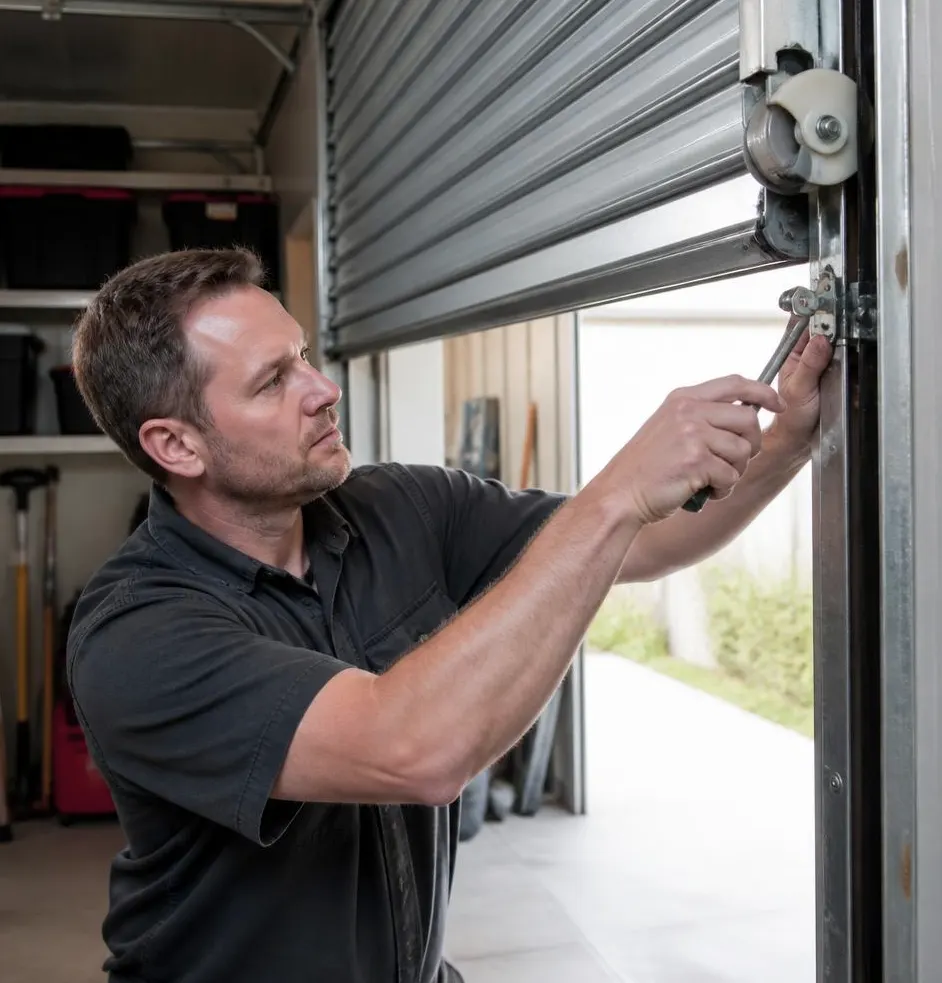
What a Technician Sees on This Kind of Call
The call usually starts the same way: one spouse is sure the garage door is the reason the AC runs nonstop, the other thinks it's nothing. On the visit, the technician kneels down at the bottom corners of the door and finds daylight coming through — sometimes a sliver, sometimes a gap wide enough to slide a business card under. The rubber weatherstrip along the bottom is cracked, flattened, or pulled loose from years of sun and heat. The side seals (if the door even has them) are brittle and shrinking away from the frame. Inside, there's often a faint musty smell, a water heater or AC air handler with condensation on the pipes, and dust lines on the floor that show exactly where outside air has been blowing in during storms.
None of that is dramatic. It's just a door that's done its job for years and quietly stopped sealing the way it used to.
How a Gap Actually Raises Your Bills
An attached garage isn't a sealed-off box — it shares at least one wall, and often ductwork or the water heater, with the living space. When outside air leaks in around a worn door, it changes the temperature and humidity of the garage itself. In this part of Florida that means the garage spends most of the year running hotter and far more humid than the house wants it to be.
That heat and moisture don't stay politely on the garage side. They push through the shared wall, through any door leading into the house, and through ductwork that often runs through the garage ceiling. Your air conditioner then has to work harder to pull that extra heat and humidity back out of the living space. It's the same reason a bathroom with a bad exhaust fan stays stuffy — the air finds a way in, and your HVAC system is the one that pays for it, cycling longer and more often than it should.
Why This Shows Up Worse Here Than in Drier Climates
In a dry climate, a leaky garage door mostly costs you temperature control. Here, it costs you both temperature and humidity control, which is a heavier lift for an AC system. Salt air near the coast speeds up corrosion on hardware and hinges, which lets panels sag slightly out of alignment — and a door that's even a little out of alignment seals worse everywhere, not just at the bottom. Add in moisture swelling the door panels themselves during the humid months and afternoon downpour season, and small gaps tend to get bigger, not smaller, over time if nothing is done.
How to Settle the Argument Yourselves
You don't need a technician to find out whether the door is actually the problem. A few checks, done together, usually end the debate fast:
- The daylight test: Close the door, turn off garage lights, and look along the bottom and both sides from inside. Any visible daylight means there's an active air gap.
- The dollar-bill test: Shut a dollar bill in the door at several points along the bottom seal. If it slides out easily, the weatherstrip isn't sealing there.
- The hand test on a hot afternoon: Run your hand slowly along the bottom seal and side seals when it's hot outside. Air movement you can feel is air movement your AC is fighting.
- The humidity check: If the garage consistently feels noticeably more humid than the house, or you see condensation on garage-stored metal, that moisture has somewhere to go — and it's not staying put.
If two or more of these come back positive, the gap is real and it's not a small thing — it's a daily, ongoing drain on both comfort and energy use.
What Actually Fixes It — and What Doesn't
Weatherstripping replacement is the cheapest and most common fix, and it solves the bottom-seal problem in most cases. But if the gaps are uneven — wider on one side than the other, or worse at the top corners — that's usually not a seal problem at all. It's a sign the door is off track, the panels have warped from moisture, or the springs have lost tension and are letting the door sag unevenly in its frame. In those cases, new weatherstripping will slow the leak but won't stop it, because the door itself isn't sitting flush in the opening anymore.
It's also worth checking the door's overall condition before and after any hurricane-season storms. Wind-load stress, driven rain, and humidity swings all put extra strain on seals, tracks, and panels in a short period, and damage from one storm season often doesn't show up as a full failure — just a slightly worse draft — until the next one.
When to Call Precision Garage Door of Cortez
If the daylight and dollar-bill tests come back positive, or the gap looks uneven from side to side, it's worth having it looked at rather than just swapping the weatherstrip and hoping. Our technicians check alignment, spring tension, and panel condition as part of a standard Garage Door Tune-Up & Maintenance visit, and if a panel has swollen or warped from moisture, we can quote Garage Door Panel Replacement instead of a full door swap. Either way, you get a straight answer about what's actually letting air through — not just a guess.
If you're going back and forth with your spouse about whether the garage door is really driving up the bills, call Precision Garage Door of Cortez and we'll settle it with a real inspection — serving Cortez, Bradenton, Bradenton Beach, Holmes Beach, Anna Maria, Palmetto, Ellenton, and Longboat Key.